
Africa comes to Oslo: the time for partnerships and investment is now
By Terje Osmundsen and Mathilde E. Thue, Chair and Managing Director of NABA, respectively.
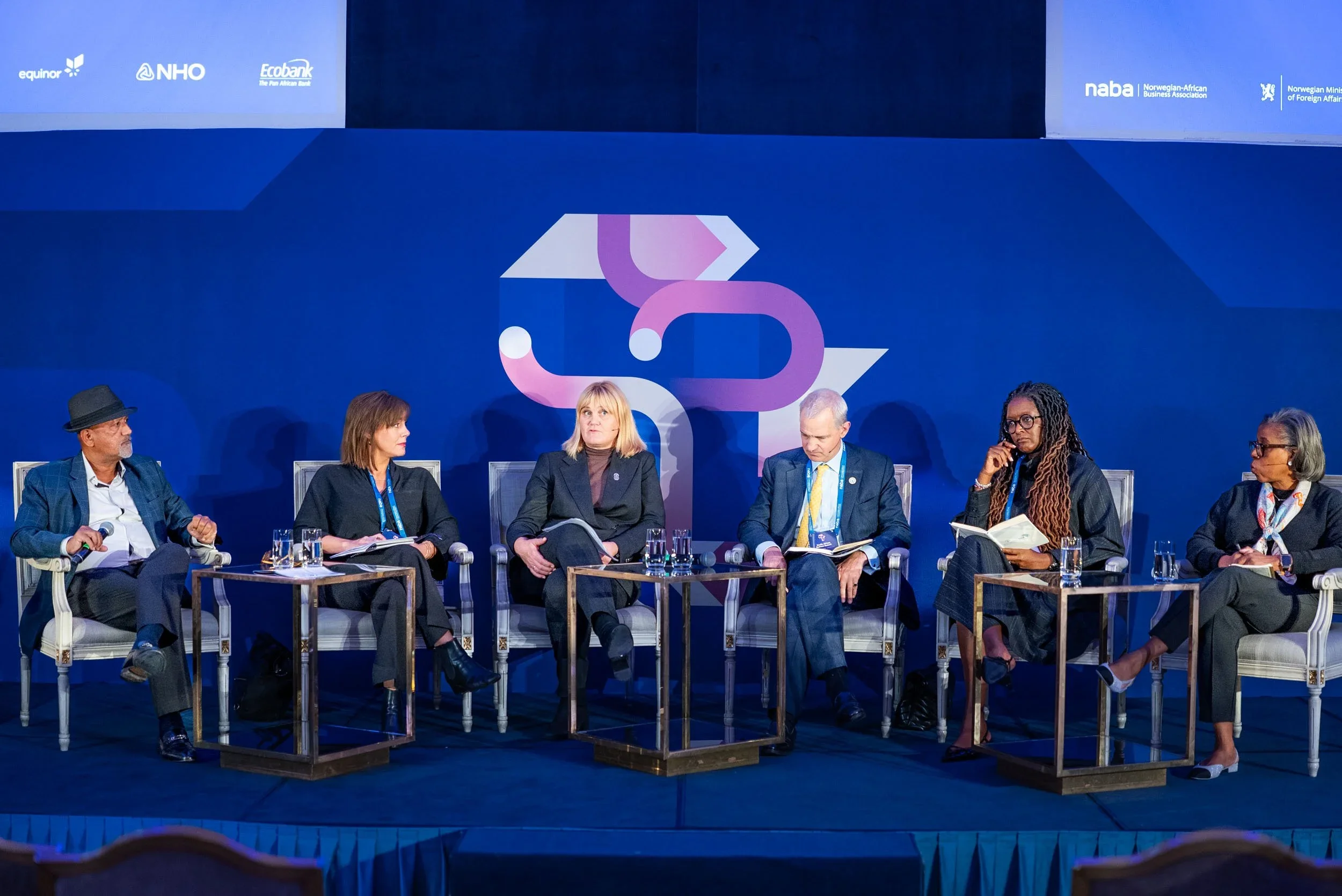
Today, October 8, more than 250 business leaders, investors, and decision-makers from various African countries and the Nordic region will gather at the Grand Hotel in Oslo. The African guests are coming to meet partners and investors, not donors.
Africa has rarely been higher on the investor agenda. For the first time in modern history, the International Monetary Fund (IMF) projects that sub-Saharan Africa will grow faster than Asia this year. Eleven of the world’s 15 fastest-growing economies are located on the continent.
Capital is following suit. The UN body UNCTAD estimates that Africa received around USD 70 billion in foreign direct investment last year—the third-highest level since 1990. Investors from the Gulf and Asia, in particular, are positioning themselves.
Over the past year, the US has also entered into a series of strategic partnerships regarding the extraction of critical minerals with the DR Congo, Rwanda, Guinea, Morocco, and Nigeria. What is new is that African countries are setting terms. In May, Zambia rejected a US proposal that would have granted American companies preferential access to the country's minerals. Nigeria is demanding local processing and quality jobs. Zimbabwe is banning the export of unprocessed lithium starting in 2027. The continent wants to process raw materials itself and needs power, infrastructure, and industrial expertise to achieve this.
This is the backdrop against which the Norwegian-African Business Association (NABA) is hosting the annual Nordic-African Business Summit, together with the Ministry of Foreign Affairs, Norfund, and the Africa Finance Corporation. Participants from the African side include, among others, the prominent businessman and billionaire Mohammed Dewji—who heads the Tanzanian industrial conglomerate MeTL—as well as leaders from Africa-based investment funds, trade organizations, and analytical firms, alongside government representatives from a number of countries. Representing Norway are Foreign Minister Espen Barth Eide and Norfund CEO Erik Sandersen, among others.
Why now?
According to the book “How Africa Works” by Joe Studwell, published earlier this year, it is only now—as population density and education levels approach critical thresholds—that sub-Saharan Africa can be said to have taken its place "at the development table." The continent has finally reached the same population density—around 50 people per km²—that large parts of Asia had when industrialization took off there in the 1950s. The proportion of adults who are literate has tripled since 1960. By 2050, one in four people globally will be African, and through the AfCFTA free trade agreement, Africa will move step by step toward a more integrated market.
However, Africa’s growth remains too low to generate sufficient jobs for a young and growing population. Consequently, African leaders are calling for investments in sectors that drive productivity and job creation: energy, infrastructure, and food production. These are the three themes of this year’s summit, and areas where Norwegian business has much to offer:
Energy. Norwegian companies were early movers in solar and hydropower in Africa. Now, more countries are opening their power grids to private players, and the demand for grid infrastructure, storage, and industrial power is growing rapidly.
Infrastructure and logistics. Ports, shipping, and trade corridors determine whether free trade becomes a reality. A maritime nation like Norway has a great deal to contribute here.
Agriculture and seafood. Africa imports tens of billions of dollars’ worth of food annually, yet possesses the land, water, and labour to meet more of its own needs. Norwegian expertise in fertilizers, fisheries, aquaculture, and value chains is in demand.
Norway is lagging behind
Norfund holds over half of its portfolio in Africa and plays a vital role in promoting investment there. Norad offers support schemes that help mitigate the risk associated with early-stage investments in Africa’s least developed countries. However, the bulk of the Norwegian business sector remains absent. According to Statistics Norway, Africa accounted for less than 1 percent of Norwegian foreign investment in 2024.
The government’s 2024 Africa strategy envisions partnerships based on equality and mutual interests. This is the right approach. Now, the strategy must be backed by measures that lower the barrier to entry for ordinary Norwegian companies.
Other countries are not waiting. Last year, Denmark introduced a dedicated Africa loan and guarantee scheme within its export and investment fund. It provides Danish companies with financing for projects carrying higher risk than the fund would otherwise accept. In addition, Impact Fund Denmark has established a dedicated Africa facility.
African business leaders do not travel to Oslo to ask for aid. They are looking for technology, capital, and long-term owners, and they have more potential partners vying for their business than before. Norwegian companies and investors are sought-after partners in Africa, the time to invest in African partnerships is now.