
What Dangote's IPO means for Africa
Ighosime Oyofo
Director, Large Corporates - Europe & Africa, Moody's
The views and opinions expressed in this article are those of the author and do not reflect the official policy or position of any organisation.
A few weeks ago Africa's richest man, Alhaji Aliko Dangote, finally launched his long-awaited IPO of his refinery company, a landmark achievement for Nigeria and Africa as a whole. Surrounded by his daughters, his colleagues, regulators and a retinue of advisers, it felt like a massive sigh of relief to watch him ring that bell at the Nigerian Exchange.
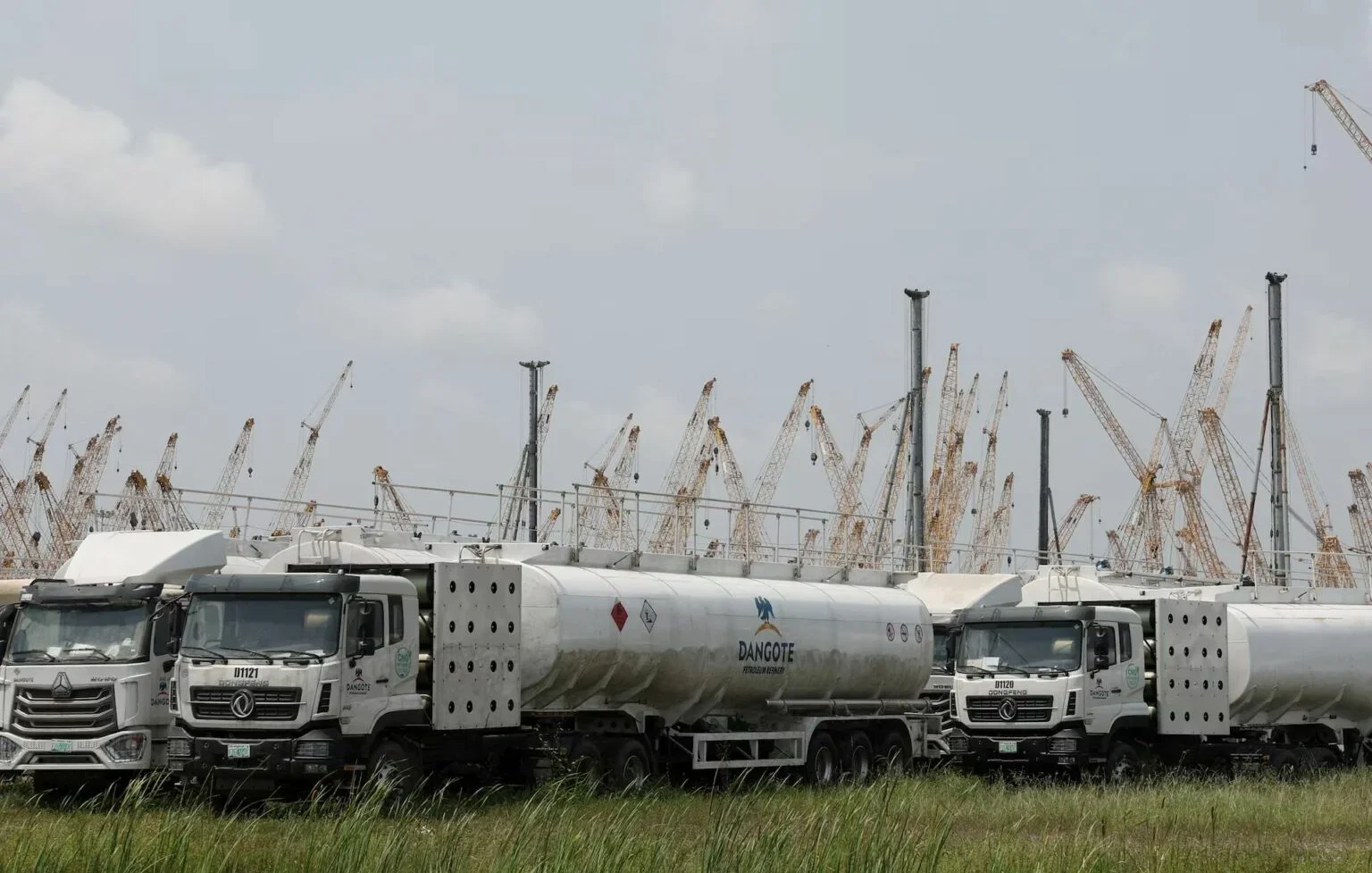
Petroleum trucks are parked near a loading bay at the Dangote Industries oil refinery and fertilizer plant site in the Ibeju Lekki district of Lagos, Nigeria March 2, 2026. REUTERS/Sodiq Adelakun/File Photo
Investors around the world, including Africans in the diaspora and other stakeholders, have the opportunity to take part in one of the most exciting African equity stories in decades.
Eventually however, the excitement will subside and we will be left with one question:
What does this ultimately mean?
In my opinion, it means that Africa's credibility story has strengthened; and while I don't mean to be flippant because Africa (as we all know) is not a monolith, there is an element of collectiveness here as regards perception. In some respects, the trust gap starts to shrink when the evidence of successfully executed large-scale projects is presented for the world to see.
While there have been a number of large projects built on the African continent, few have successfully achieved the scale and scope of this refinery - costing over $20 billion to complete. This might also be considered a bit of a celebrity opportunity; investing in the IPO launched by Africa’s richest man has a different ring to it and generates a different level of excitement than most other opportunities.
This IPO is a significant milestone and perhaps a template of what great execution might look like, though one might argue that the story was far more complicated. Nevertheless, it’s an inspiring development that suggests that investors might gain renewed confidence as regards investing in Africa.
The Trust Gap
Africa as a whole has long been considered a risky investment proposition but to varying degrees given that country risk in Ghana is different to that of Mauritius. There are many reasons for this risk perception, but one of the key factors in this regard is data, or lack thereof. Much of this lack of data is due to lower levels of required disclosure compared to more developed markets but there is also less data as a result of fewer projects and transactions being completed. But this is starting to change as the trust gap narrows.
Another factor is in how the stories are told, which informs how various destinations on the continent may be viewed. A lack of information does not necessarily mean a lack of results, as can be seen by the performance of several capital markets across Africa, with Zimbabwe, Ghana and Tunisia for instance having all achieved stock market returns in excess of 46% across 2026 thus far. Nigeria’s NGX All Share Index sits at 60.5% YTD 2026 and in fact has been recently restored to the FTSE Russell Index as well as the JP Morgan’s GBI-EM Edge Index.
Indexes such as the above are trusted sources of information and credibility for investors that are looking to put capital to work in these markets. There are of course other measures that have been introduced more recently, such as the AT50 (Africa Tech 50) Index which is positioned as a benchmarking tool, providing investors with a useful lens through which to assess other African tech investment opportunities in the private markets. These initiatives and others suggest an increasing shift towards greater transparency signaling that Africa as a whole is preparing for scale across multiple avenues.
What comes next?
This Dangote moment signifies a certain level of readiness for Africa. And in fact, the recent discussions between Dangote and several Norwegian companies in respect of potential partnerships demonstrates a level of seriousness that can lead to some real wins for the continent. And indeed there are some on the way when you consider massive projects such as the Trans Sahara Pipeline, the Tanzania LNG Project and of course the much celebrated Lobito Corridor.
But we need more. We need more Dangotes, more Motsepes, more Dewjis, more Sawiris and more Rabius. With the natural resource base, population demographics and energy potential, the continent is well positioned for more success stories of entrepreneurs helping to accelerate capacity and development.
“We need more Dangotes, more Motsepes, more Dewjis, more Sawiris and more Rabius.”
The question then becomes, how do we build them? How do we build these larger going concerns of tomorrow?
There are hundreds, if not thousands of entrepreneurs around the continent that are running profitable, tax-compliant business and servicing real needs. But many of them do not yet have that ability to scale in a meaningful way and I believe that the biggest reason behind this is access to the right kind of capital. In some instances, this would be domestic capital, but even then, the type of capital might not yet be a fit for the opportunity and creative alternatives are required.
If the Dangote story has proven one thing, there is substantial African capital ready to participate in large, de-risked investments, whether on the continent or outside. But having strong, long-term partners with patient capital is where a lot of ground can be gained, particularly as many of these smaller businesses need time and support early on. Sometimes the issue is being able to ride out certain political cycles, other times it could be due to global supply chain dislocations and often it is the cost of capital itself.
And this is where opportunities for the global finance community lie. We have seen a lot of innovation in the form of blended finance, with first-loss instruments and risk sharing mechanisms, but I suspect there is still more that can be unlocked. With the right investment mindset and a collaborative, stakeholder focused approach, I believe we are just beginning to scratch the surface of what is believed as Africa’s potential.
Podcast
Listen to Aliko Dangote "In Good Company" hosted by Nicolai Tangen, CEO of Norges Bank Investment Management:
